China's blue-chip stocks hit the edge of a bear market as stimulus hopes fade
The CSI 300 fell as much as 1.6% Thursday, leaving it around 20% below its June high, as a soft earnings season, a consumer slump and AI jitters meet fading hopes for big stimulus from Beijing.
By James Mitchell ·
For information only, not investment advice.
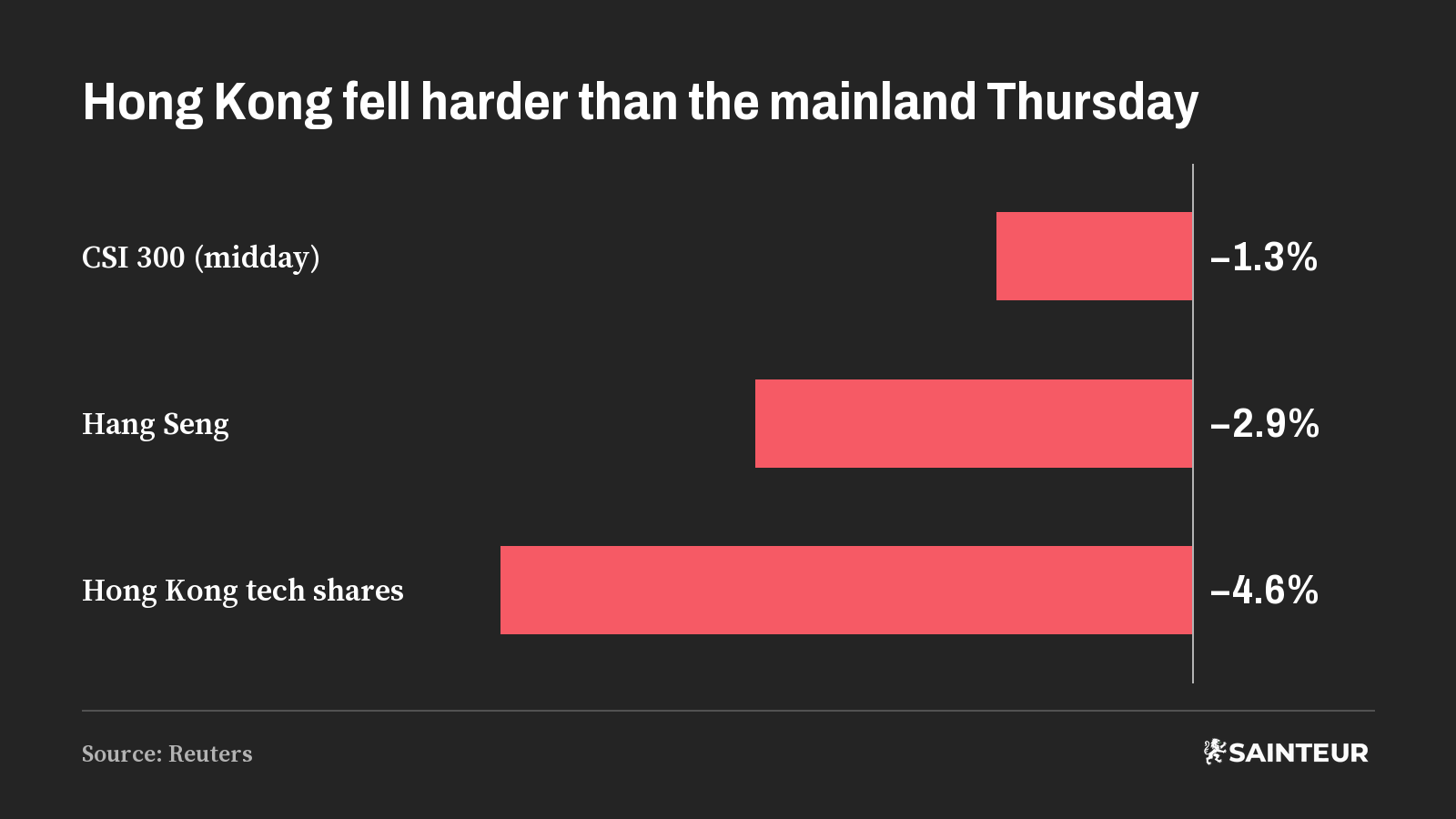
China's biggest mainland stocks are knocking on the door of a bear market. The blue-chip CSI 300 index fell as much as 1.6% on Thursday, Bloomberg reported, bringing its losses from a June high to around 20%, the line widely used to mark a technical bear market. At Thursday's midday break the index was down 1.3% and "nearly 20%" below its June peak, according to Reuters.
CNBC reported that the index entered bear-market territory Thursday, falling 20% from its June peak, while Bloomberg and Reuters described it as on track for, or nearly at, the 20% line intraday; none of the reports gives the close. Either way, the trend is not subtle: the index has declined for 10 consecutive weeks and was down 2.6% so far this week, CNBC reported, citing LSEG data. On Wednesday it closed down 1% at its lowest level since August 2025, while the Shanghai Composite lost 0.6%, Reuters reported.
Hong Kong took a harder hit
The selling was steeper offshore. In Hong Kong, the benchmark Hang Seng index fell 2.9% on Thursday and the city's tech shares dropped 4.6%, Reuters reported. Bloomberg said a gauge of major Chinese companies listed in Hong Kong dropped as much as 2.9%.
How it got here
According to Bloomberg, mainland shares have been sliding since late June. They first got caught in the global selloff in AI-linked stocks, then sank further on new evidence of a protracted slump in consumer spending. Bloomberg pointed to three weights on sentiment: waning hopes for substantial stimulus, lackluster earnings, and lingering jitters over the global AI trade.
Earnings haven't helped. Contemporary Amperex Technology, the battery maker better known as CATL, reported slower-than-expected quarterly profit growth as policy support wound down, and its shares fell 12% on Wednesday, Bloomberg reported.
Why Beijing isn't rushing in
Here's the twist: some of the bad news for stocks comes from good news for the economy. China's growth beat in the third quarter kept expansion within the government's annual target, which, as Bloomberg put it, gave policymakers room to stick with targeted and incremental stimulus. Barclays made the same point bluntly in a note cited by Reuters: "With the growth target largely secured, we see a higher bar for large-scale stimulus."
Investors had already been let down once. "China's limited stimulus measures announced ahead of the National Day holiday, including mortgage interest subsidies for first-time buyers of lower-priced properties, disappointed market expectations," Kelly Chung, chief investment officer for multi assets at Value Partners, told Reuters.
Sophie Altermatt, an economist at Julius Baer, said in a note that Beijing's priorities lie elsewhere: "Rather than seeking to boost near-term growth, the government's focus remains on technological advancement, industrial upgrading and greater self-sufficiency," Reuters reported.
What to watch
Authorities have moved to curb selling pressure and steady the market, though analysts said state-backed buying alone may not be enough for a sustained recovery, according to a Bloomberg report carried by CNBC TV18. For anyone holding Chinese stocks or funds that own them, the open question is the one Washington watchers know well: whether policymakers decide the market's pain is their problem. So far, with the growth target largely secured, the signals point to small steps rather than a big rescue.
Sources
- China Stocks Set for Bear Market as AI Trade, Policy Hopes Fade, Moneycontrol (Bloomberg)
- Chinese stock market in bear territory after 20% fall from June peak, CNBC TV18 (Bloomberg)
- China's CSI 300 bear market, CNBC
- China's blue-chip index hits 14-month low, Business Recorder (Reuters)
- Hong Kong stocks slide to 4-month low as stimulus hopes fade, Free Malaysia Today (Reuters)
Tags: china · markets-moves · analysts · ai