Meta's capital spending pushed its free cash flow negative, and its default insurance hit a record
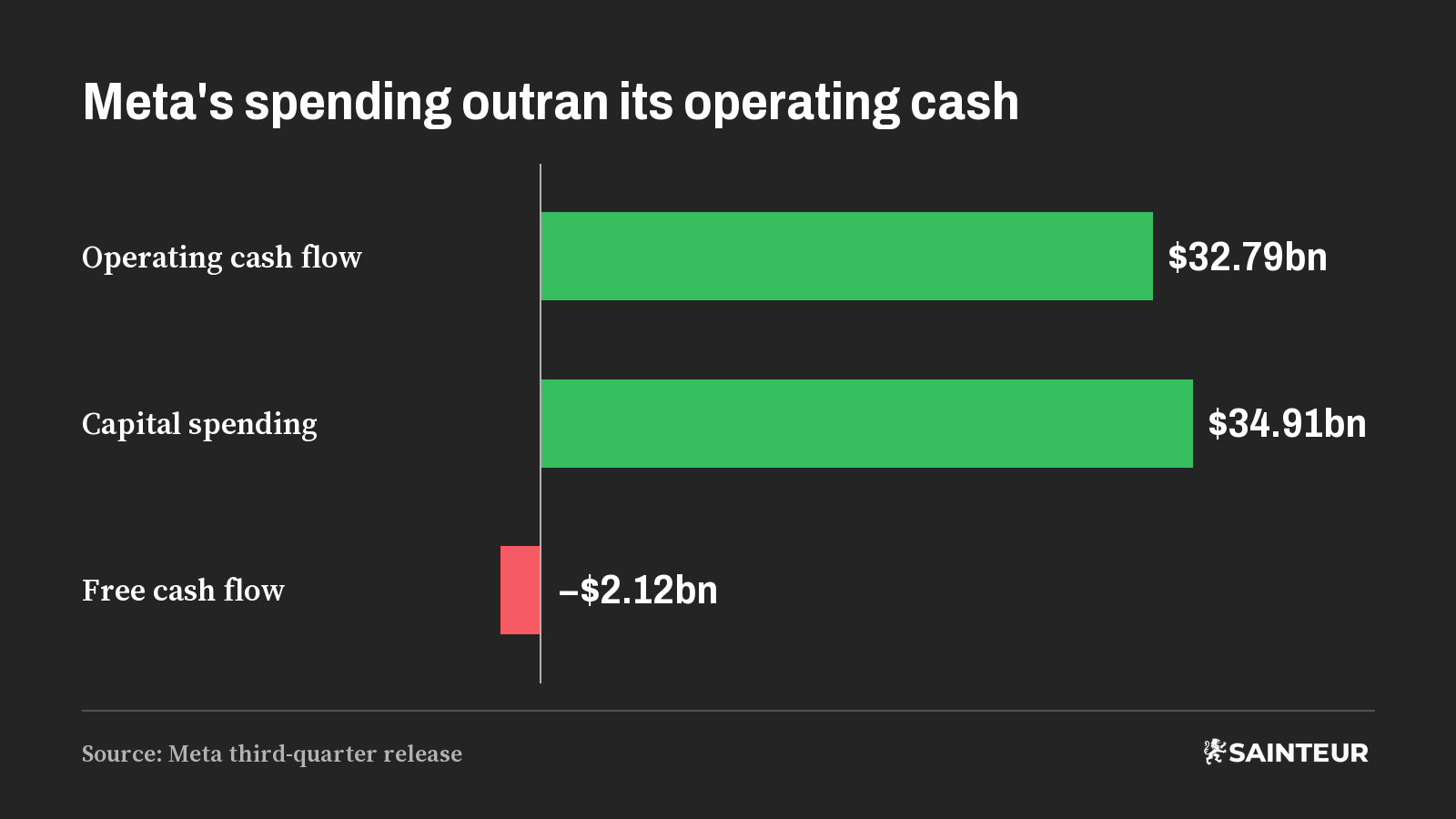
Meta's free cash flow came in at negative $2.12 billion as capital spending outran operating cash. Its five-year credit default swaps hit a record and the stock fell, even though revenue topped estimates.
By Marcus Rodriguez ·
Why it matters: Meta's buildout cost more than its operations generated in cash last quarter, and both stock and credit markets reacted.
For information only, not investment advice. Prices delayed.
Tickers: META
Meta ($META) beat on revenue and still had a rough Thursday. The stock was down 8.08% at $641.14 as of Oct 22, 3:00 PM ET, and the cost of insuring its debt against default hit a record. Reuters reported that the selloff came "despite better-than-expected results and a strong forecast."
The number people skipped on the way to the revenue line was cash. In its third-quarter release, Meta said operating cash flow was $32.79 billion, while capital expenditures, including finance-lease payments, were $34.91 billion. That left free cash flow, the cash left after paying for buildout, at negative $2.12 billion. Reuters said it was the first time Meta's free cash flow turned negative since 2012. Meta also raised the low end of its 2026 capex outlook, which now runs $135 billion to $145 billion, up from $130 billion to $145 billion.
The rest of the report was solid. Revenue rose 26% to $64.60 billion, against the $63.37 billion analysts expected, according to CNBC. Meta guided fourth-quarter revenue to $73 billion to $76 billion. Diluted earnings per share came in at $3.83, but that includes a $9.89 billion charge tied to Meta's agreement with state attorneys general; without it, Meta says EPS would have been $7.40. CNBC said it wasn't clear whether $3.83 compares directly with the $5.75 Wall Street was looking for, so call it neither a beat nor a miss.
Then there's the credit market. Credit default swaps are contracts that pay out if a borrower defaults, so their price is a rough gauge of how nervous lenders are. Reuters reported that Meta's five-year swaps widened 7.6 basis points to a record 114.79 basis points, per Markit data, on track for their biggest one-day jump since at least 2025. Not everyone reads that as default fear: Futurum's Shay Boloor told Reuters the surge "could have more to do with banks hedging exposure to Meta's massive AI debt financing than actual default risk."
Shareholders also have the new stock to digest. Meta's board approved a publicly listed, non-voting Class C share, effective January 2027, handed out as a one-for-one stock dividend. Reuters reported Meta said it could raise hundreds of billions of dollars through such issuances over several years, starting as early as fall 2026, and that the filing said this helps avoid debt that could hurt its credit ratings. Interactive Brokers' Steve Sosnick told Reuters that investors are "interpreting the new non-voting shares as a backdoor for issuing more stock and diluting holdings eventually," which he said was adding to the selloff.
Mark Zuckerberg, for his part, said in the release that "Our investments are paying off, the core business is strong, and we're seeing velocity across the board." The market, on Thursday at least, wanted to see the cash.
Sources
- Meta Reports Third Quarter 2026 Results, Meta Platforms (via PR Newswire)
- Meta stock sinks 6% as AI spend pushes free cash flow negative, CNBC
- Meta's credit risk indicator hits record high on increased AI spending plan, Reuters (via CNA)
- Meta shares slide, default insurance hits record as AI spending alarms investors, Reuters (via CNA)
Tags: earnings · big-tech · ai · markets-moves · guidance