Private equity's defense tech rush is a bet on the next buyer, not the battlefield
Buyout firms poured $4 billion into defense growth deals in nine months, per PitchBook. The money is real, but the trade only works if a later buyer pays up for promise.
By Connor O'Brien ·
Why it matters: Private equity is moving into defense deals venture capital used to own, and its payday leans on IPOs, so public market buyers may end up holding the risk.
For information only, not investment advice.
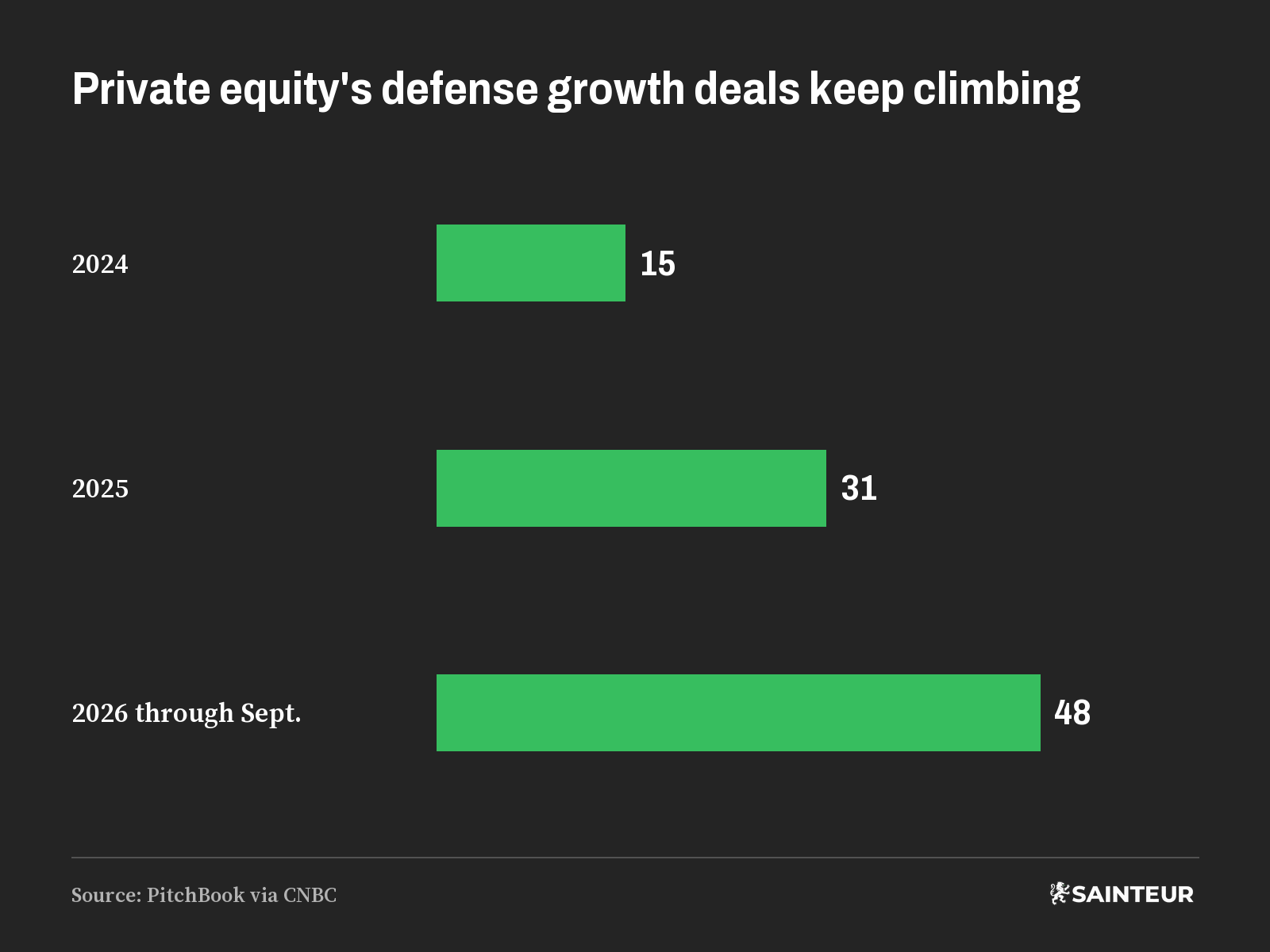
Private equity has discovered defense tech, and it is not being shy about it. Per PitchBook data reported by CNBC, private equity growth investments in defense reached $4 billion in the first nine months of 2026, up from $500 million in 2024. The deal count went from 15 in 2024 to 31 in 2025 to 48 through September. Growth deals made up 41% of defense PE deal value this year, against 3% in 2024.
PitchBook analyst Jim Corridore put it plainly: "It is clear to me that PE is moving into territory VC used to own." My view: that move makes sense for the companies, and it should make everyone else nervous about the exit.
The case for the money
Start with the best argument against me, because it's a good one. Analysts quoted by CNBC say private equity, debt and other financing are expected to matter more in bridging the gap between innovation and industrial-scale production, since venture capital alone may not be enough to pay for expansion. Building things at scale is expensive, and someone has to write those checks.
Corridore also pushes back on the bubble talk. "Budgets are growing, the military has used up a lot of ammunition, and new drone and counter-drone technology is arriving," he said. "All of that gives investors the steady revenue PE needs to make long-term bets." And not every corner is frothy: Weinberg Capital's Lionel Mestre said valuations for the smaller, established defense suppliers his firm targets had not increased significantly.
Fair. If the buyers were paying for order books and steady contracts, I'd call this a sensible grown-up phase for the sector. That's not quite what the people doing the deals describe.
Priced on promise
Advent committed in March to invest up to $1 billion in next-generation defense technology companies, starting by co-leading Shield AI's $1.5 billion Series G at a $12.7 billion valuation. It then joined Saronic's $1.75 billion Series D at a $9.25 billion valuation. Advent's Shonnel Malani told CNBC the firm has already deployed roughly three-quarters of that commitment.
Here's the part I can't get past. Malani, whose firm is actively writing these checks, said defense tech companies are increasingly valued on their technological promise rather than revenue, profit or order books. He said there is "a lot of froth in the system," that Advent walked away from several deals because valuations had become "silly," and, asked whether a bubble could emerge, "I think there is a very big risk of that." He added that a correction may be inevitable as some companies struggle to turn promise into commercial success.
When the buyer is warning you about the price, listen. Corridore's steady-revenue argument is about the military's demand. Malani's warning is about what investors are paying for a share of it. Both can be true at once, and the second one decides who makes money.
The exit is the whole trade
Private equity has to sell eventually, and per PitchBook, IPOs accounted for 70% of defense PE exit value through September 2026, which CNBC notes leaves investors exposed to changing stock market conditions. Malani also said some startups were rushing toward IPOs before developing the operational maturity needed to become sustainable public companies.
Put those together and the plan reads like this: buy on promise in a private round, then hand the promise to public investors before it has become a business. PitchBook counts 504 defense PE deals and 101 exits since 2021. That comparison includes add-on acquisitions, so it isn't a clean measure of how many investments are still waiting to cash out, but it does tell you the money has gone in much faster than it has come out.
And the wave isn't slowing. According to a Dealroom report covered by Resilience Media, defense startups across NATO and allied countries have raised $27.1 billion so far in 2026, already 1.9 times all of 2025, and Dealroom projects $38.5 billion by year-end.
None of this means defense tech is a bad business or that the capital is wasted. Scaling up production needs funding, and private equity can supply it. My argument is narrower: when growth is priced on promise and most of the exit value runs through IPOs, the real bet isn't on drones or ammunition demand. It's on a public market that's still in the mood to pay up. That's a market call, not a defense call, and it deserves to be described as one.
Sources
- Defense tech investment boom sparks bubble warning as private equity pours in, CNBC
- Advent expands defense focus with commitment to invest up to $1 billion in next-generation defense technology, Advent International
- Advent advances up to $1 billion defense technology commitment with investment in Saronic, Advent International
- State of Defence Tech 2026: European defence startup funding to quadruple to $10.5B, Resilience Media (Dealroom report)
Tags: venture-capital · valuation · funding-round · ipo · unicorns